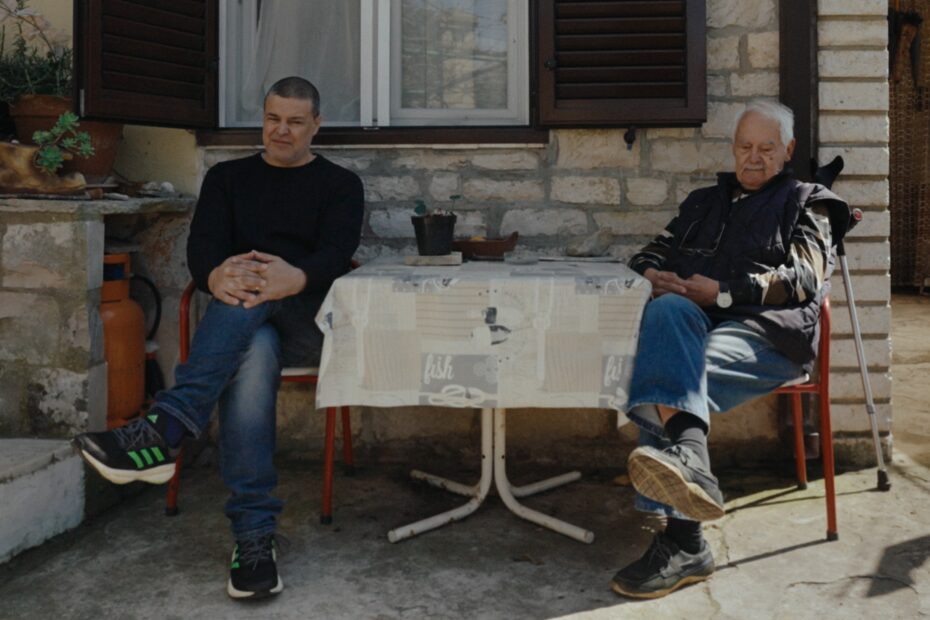
The Audience Award at this year’s Sarajevo Film Festival went to a film that was also part of the programme on the final evening of BH Film. It is the documentary WE SHALL LIVE TOGETHER by Damir Markovina, a director and actor from Mostar who now resides permanently in Zagreb. Both origin and place of residence are of particular importance to this film, especially for those generations among us who either remained during the war or left as children, following the decisions made by our parents. Our parents, on the other hand, had to decide whether to stay or leave virtually overnight. Both they and we—parents and children alike—have been forced to live with the consequences of those decisions for more than thirty years.
Damir Markovina places his father, Roko Markovina, at the centre of the film—once a respected, and later an unwanted and exiled Social Democratic member of parliament from Mostar—alongside his mother, brother, and himself, whose lives were shaped and defined by the consequences of Roko’s decisions. Roko, however, made his decisions according to one fundamental and inviolable principle: his honour (“these two fingers’ worth of dignity” is a phrase Roko often uses in his own defence, and one his sons just as often mock). On the one hand, this sense of honour and steadfastness makes him a figure of chivalry in the eyes of all of us who agree with the moral basis of his decisions: the city of Mostar, as well as the whole of Bosnia and Herzegovina—and the former Yugoslavia—belongs to all its citizens, regardless of their ethnic or religious affiliation. Thus, in 1992, in the midst of the war in Bosnia and Herzegovina, while Croatia was burning, Roko stood in defence of equality and against nationalism. He became increasingly isolated in his struggle—his comrades either left Mostar, thereby saving their families, or joined the victorious nationalist camp. Roko remained alone. For the sake of his principles, Roko put his family’s future on the line. And this brings us to the other side of the story. His sons, Dragan and Damir, then teenagers, as well as his wife Zina, became refugees and, in a way, have remained so to this day. Roko stayed alone in Mostar, continuing to fight for his principles even though he knew he was losing, and was eventually forced out of the family apartment in his own city. Even this did not stop his struggle—at the end of the war, he was one of the few politicians in the Parliament of the Republic of Bosnia and Herzegovina to raise his voice against the unjust division of the country formalised by the Dayton Peace Agreement.
Today, Roko lives with his wife Zina in self-imposed exile in a small house on an island. He visits Mostar to take care of current affairs, check on the apartment, and visit the graves, but refuses to return. And this greatly frustrates his sons. Dragan, a historian and political commentator whose work focuses on nationalism, memory politics, and the post-Yugoslav region, has almost returned to Mostar. For his research, there could hardly be a better case study than this city. Damir still lives in Zagreb, but his strongest authorial voice emerges when he explores these same themes in his documentaries—such as DESERTERS, about his friends and classmates from secondary school, most of whom are no longer either in Mostar or alive. Zina wants to return to Mostar; she would like to live in the city again. Once more, everyone expects Roko to make the decision. And once again, his refusal angers them. Is honour merely stubbornness? Is honour selfishness?
Our sympathies certainly lie with Roko. At times, his sons come across as spoiled and self-centred, constantly attacking their father over decisions he made out of a sense of honour, but also out of the deepest human principle. Yet Roko is not alone. Many people from Damir’s and Dragan’s generation, or those only slightly younger, blame the parents who stayed during the war and, in the name of ideals, put both their own lives and the lives of their children on the line. A whole series of documentaries still needs to be made about the consequences of growing up under such circumstances and everything this has meant for the lives of those who survived. Yet, after all is said and done, WE SHALL LIVE TOGETHER—named after one of the slogans used at pre-war rallies of the Socijalist Democrat Party—reveals that we, too, are making our own decisions today, decisions that can and must be questioned in the same way as those made by our parents. This is also at the heart of the film’s ending, when Damir and Roko discuss the possibility of returning, and Roko turns the same question back on Damir: “Why can’t you live in Mostar? But you live in Zagreb?”
Bojana Vidosavljević